
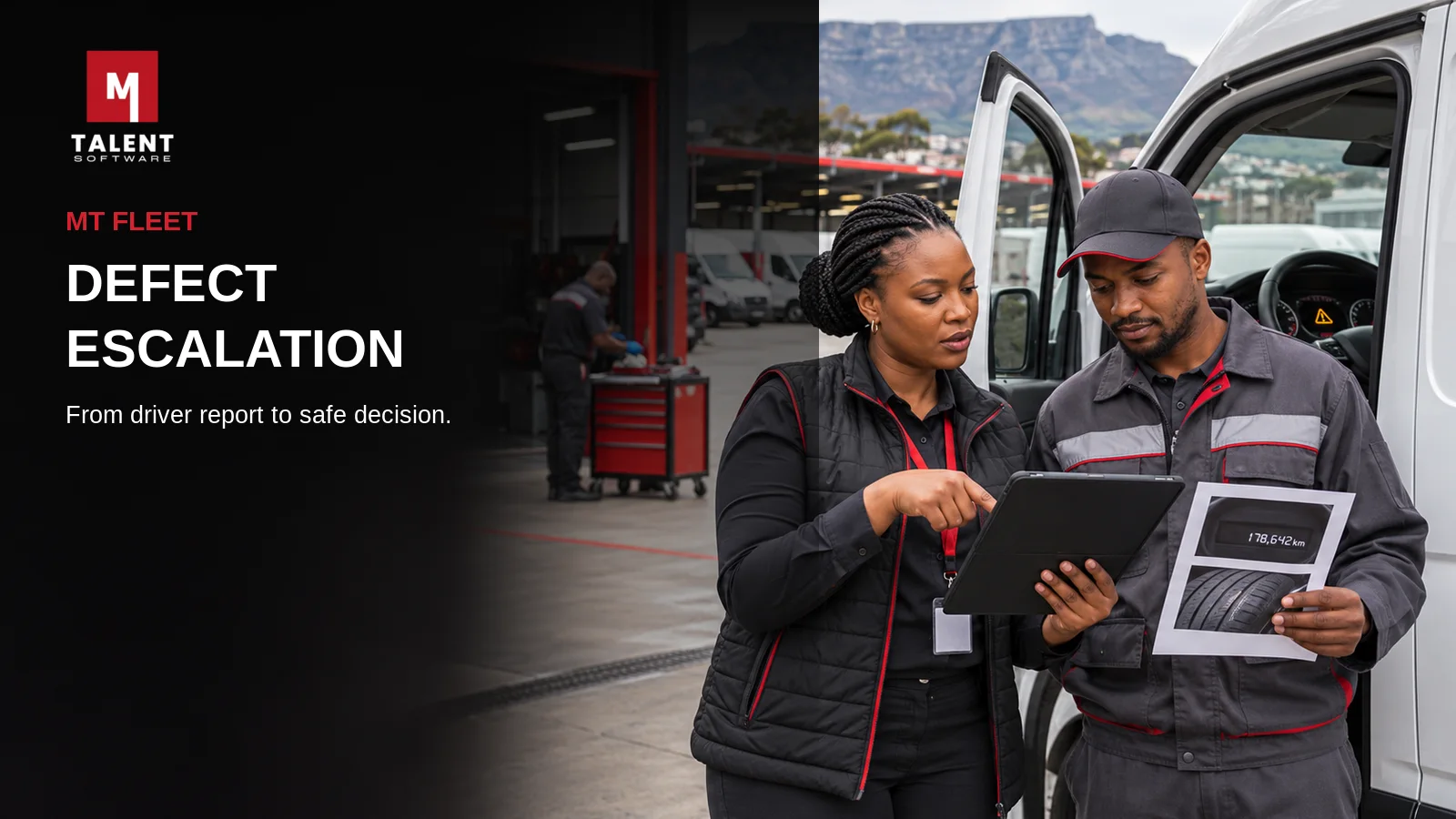
A driver notices an amber warning light during the morning run and sends a message to a supervisor. The vehicle still moves, so the driver finishes the route. The supervisor assumes fleet operations will arrange a check. Fleet operations never sees the message, and the same van is allocated to another driver the next morning.
The warning light is not the only risk. The real weakness is a defect report with no formal status, owner or response time. A controlled escalation turns an observation into a decision: what the vehicle may do now, who assesses it, what evidence is needed and who decides when it can return to normal service.
Give the vehicle an immediate status
Start by recording whether the vehicle is available, available with an approved limitation, or out of service pending competent assessment. That status should be visible to the people allocating vehicles and keys. A message saying “please check when possible” leaves too much room for interpretation.
Do not guess about safety from the colour of a warning light alone. Use the organisation’s safety procedure, the vehicle manufacturer’s guidance and an appropriately competent person. If the condition is uncertain, pause the next journey until the responsible person has made a documented decision.
Capture the report before details disappear
Record the vehicle registration or fleet number, driver, date, time, location and odometer reading. Add the exact warning shown, any change in noise, power, braking, steering, temperature or smell, and whether the condition changed during the journey. Photographs can help when they are permitted and taken safely.
Preserve what the driver observed. Do not ask someone to clear a warning, disconnect equipment or repeatedly restart the vehicle simply to make the dashboard look normal. The workshop needs the original symptoms and sequence, not a tidier story.
Classify the escalation route
A useful workflow separates urgent safety concerns, faults needing prompt technical assessment and lower-priority defects that can be planned. Each class needs a named escalation route and response target. Drivers should not have to decide technical severity alone, but they must know who to contact and what to do while waiting.
If the responsible assessor needs more information, record the questions and answers alongside the original report. That protects the evidence trail and prevents several people asking the driver different questions without reaching a decision.
Assign one owner and a deadline
Name the person accountable for moving the defect to its next state. The owner may need to speak to the driver, arrange recovery, request a workshop booking, update dispatch or obtain approval. “Fleet team” is not specific enough when a vehicle is waiting.
Set a response deadline based on the agreed severity. If responsibility changes between shifts, hand over the vehicle status, outstanding action, workshop contact and next update time. The defect remains open until somebody has accepted that handover.
Control the next journey
A technical decision must reach operations. Update the vehicle plan, key control, driver allocation and any dependent route or customer commitment. Where a replacement vehicle is used, identify who informs the next driver and who revises the operating schedule.
Do not rely on a note placed inside the vehicle. The allocation record should agree with the defect status so that a colleague who was not present can make the right decision.
A practical example
A delivery-van driver reports an amber engine warning and reduced power after leaving the depot. In an informal process, the driver texts the shift supervisor, finishes the route and parks the van. The next shift sees the vehicle in its normal bay and assigns it again because no restriction is visible.
In a controlled process, the supervisor records the report immediately, marks the van out of service pending technical assessment and captures the odometer, location, warning and symptoms. A fleet coordinator owns the next action, confirms the workshop assessment and gives dispatch a response time. The next driver receives a replacement allocation before arriving for the keys.
After the workshop has assessed and repaired the fault, the coordinator records the work completed, any follow-up condition and the person authorising return to service. Operations then receives an explicit release. The fault is not closed simply because the warning light has disappeared.
Close with a return-to-service decision
Keep the record open until the technical outcome, documents, costs or approvals required by the business, and any next action are captured. Confirm the vehicle status, notify the affected driver and dispatch team, and retain the link between the original report and the completed work.
Review repeated warnings, slow response times and defects reopened soon after closure. Those patterns can reveal unclear driver instructions, weak shift handovers, delayed workshop access or return decisions made without evidence.
MyTalent MT Fleet focuses on the fleet side of your business, including fleet operations, vehicle overview and your team. Explore MT Fleet or talk to our team about the capabilities available for your operation.
A reported defect is under control when the vehicle has a clear status, the evidence is preserved, one person owns the response, operations knows the restriction and a competent return-to-service decision closes the loop.