
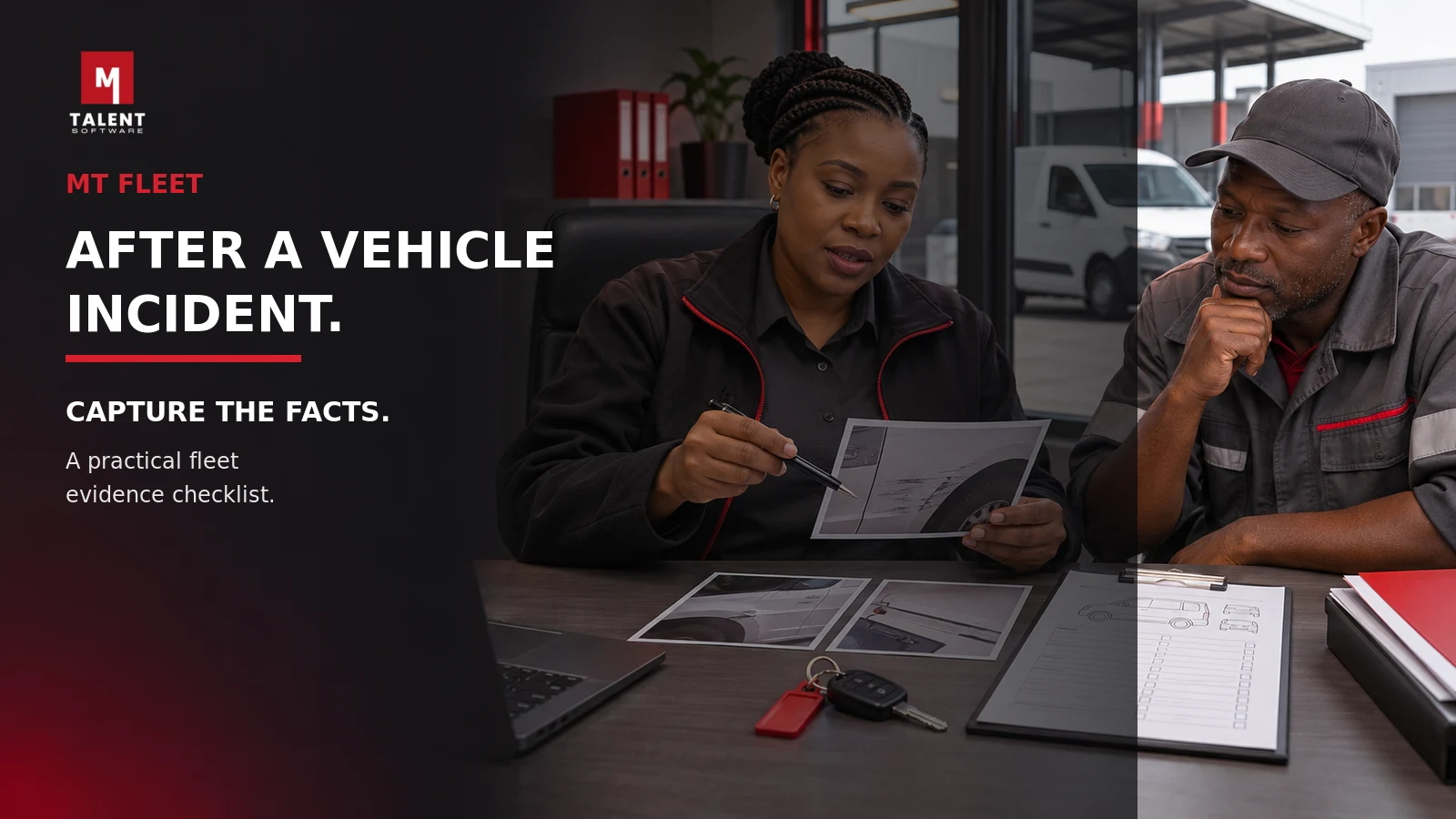
A delivery vehicle clips a loading-bay barrier. Nobody is hurt, the vehicle can still move and the driver phones the office straight away. By the time the fleet manager asks for the details, however, the vehicle has left the site, the only photograph is a close-up of a scratched panel and nobody recorded the barrier owner’s contact information.
The problem is not a lack of effort. It is the absence of a simple evidence routine. A vehicle incident can involve safety, operational, insurance, maintenance and customer decisions. Those decisions become harder when the original facts are incomplete, mixed with assumptions or scattered across messages. A practical checklist helps the team protect people first, then create a dependable record.
Start with safety, not paperwork
The first instruction should always be to make the situation safe. The driver should follow emergency, company and legal procedures, contact the appropriate authorities or emergency services where required, and avoid taking photographs or gathering details if doing so creates danger. An incident checklist must never encourage someone to stand in traffic, obstruct responders or move an unsafe vehicle.
Confirm whether anybody is injured, whether there is an immediate hazard and whether the vehicle can remain where it is. Record who made the safety decision and at what time. If the vehicle is moved, note why and, where safe, capture its original position beforehand.
Identify the vehicle, driver and journey
Capture the vehicle registration or fleet number, the driver’s name, the date and time, the precise location and the purpose of the journey. Add the route, delivery, customer or job reference if one exists. This small set of identifiers connects the incident to the right operational records without relying on memory later.
Also record who first received the report. That person should own the immediate evidence check or assign it explicitly. “The office knows” is not ownership; a named person and next review time are.
Build a useful picture of the scene
Where it is safe and permitted, take wide photographs that show the overall scene before taking close-ups of damage. Capture the vehicle from several angles, the road or site layout, relevant markings, signs, barriers, fixed objects and visible conditions such as lighting or weather. A close-up can show a dent, but it rarely explains where the vehicle was or how the surroundings were arranged.
Keep original files rather than editing, cropping or forwarding them repeatedly. Note who took each photograph and when. If video, telematics or site-camera footage may exist, record the source and the person responsible for requesting it promptly, because some systems retain footage for only a limited period.
Record people and reference details
Collect the other party’s name and contact details, vehicle or property details, and the information required by your organisation’s process. Record witness details separately and note whether they actually saw the event. Add authority, towing, recovery or site-security reference numbers as they become available.
Do not turn the scene into an argument about blame. Ask the driver for a factual account: what they were doing, what they observed and what happened next. Keep observation distinct from interpretation. “The barrier was on the driver’s left” is a fact; “the site owner caused it” is a conclusion that the evidence may not yet support.
Control the vehicle after the event
Record whether the vehicle was driven, recovered or towed, where it went and who received the keys. Photograph its condition on arrival where appropriate. If there is uncertainty about roadworthiness, place the vehicle on hold until a competent person completes the required assessment. Operational pressure should not convert an incident into a second safety risk.
List any load, customer property or equipment affected and assign the next action. Preserve repair estimates, inspection findings, recovery invoices and other supporting records under the same incident reference so the history does not fragment.
A practical example
Return to the delivery van and loading-bay barrier. With a checklist, the driver first confirms there are no injuries and follows the site’s safety instructions. The fleet coordinator records the vehicle, driver, delivery reference, time and bay number, then asks for a wide scene view, vehicle angles, close-ups of both areas of damage and the loading-bay signage.
The coordinator obtains the facilities contact, site-security reference and the name of a witness. The driver writes a short factual account without guessing who is liable. Back at the depot, the keys are handed to the fleet supervisor, the vehicle is held for inspection and the follow-up owner is named.
The checklist does not decide fault or guarantee an outcome. It gives the people responsible for safety, operations, repairs and any insurance process a coherent starting point. It also prevents repeated calls to the driver for details that could have been captured once.
Use a visible incident path
A practical status path is incident reported, immediate safety confirmed, evidence gathering, vehicle assessment, third-party follow-up, actions assigned and complete. Add an owner and due date to every outstanding item. If a document or reference is unavailable, record that fact and the next attempt instead of leaving a silent gap.
Review the completed record before closure. Check that dates, names and references agree; that the current vehicle status is clear; and that promised updates have been sent. Restrict access to personal or sensitive information and retain records according to your organisation’s policies and applicable requirements.
MyTalent MT Fleet is designed around the day-to-day needs of fleet operations. Explore MT Fleet or talk to our team about the capabilities available for your business.
A strong incident record is not the longest report. It is a timely, factual and organised account that protects people, preserves evidence and makes the next action unmistakable.