

Why Generic CRMs Fail Education Recruitment Agencies
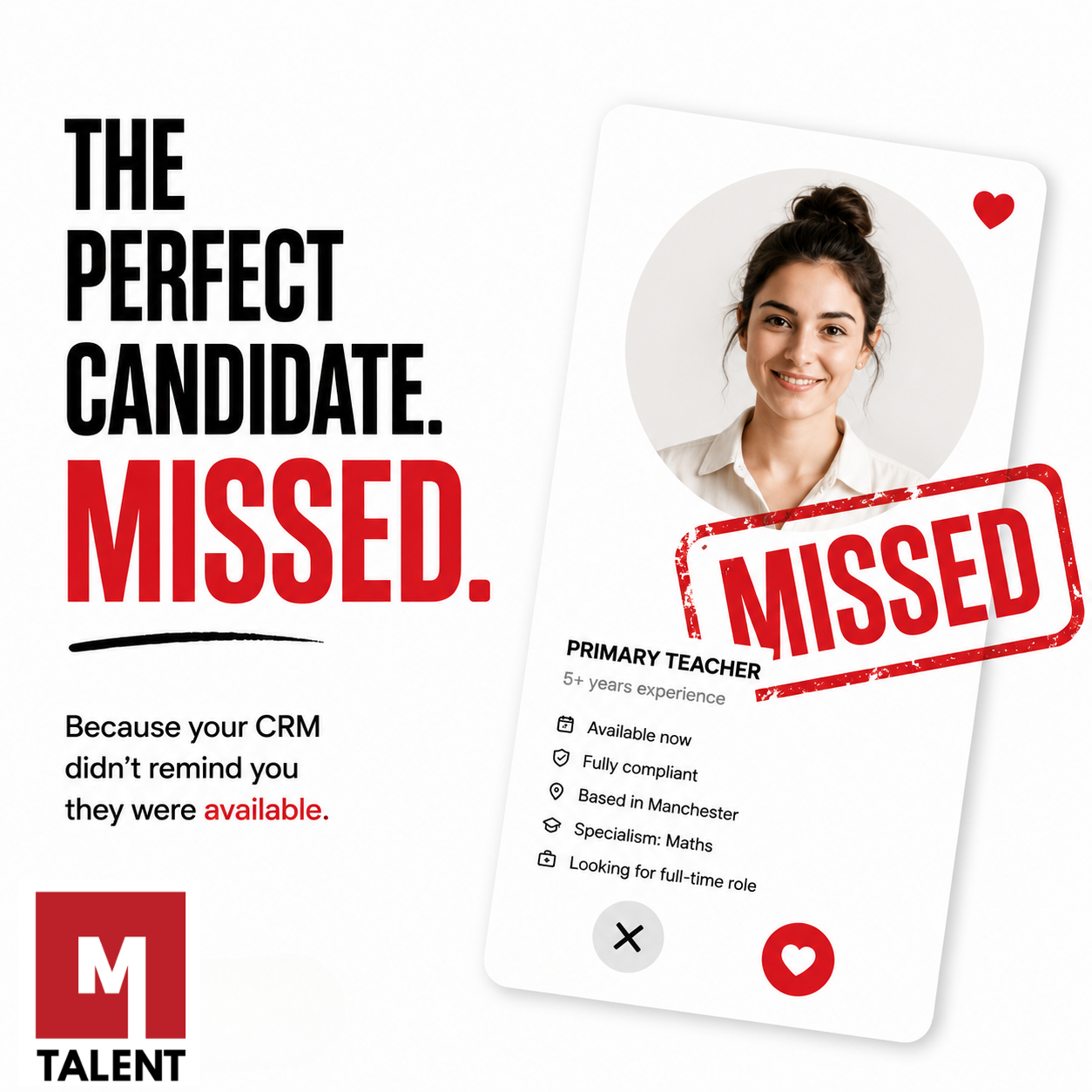
CRM systems have become the backbone of modern recruitment businesses. They help teams manage candidates, clients, placements, communications, and reporting – all from a central platform.
Yet many education recruitment agencies find themselves wrestling with a frustrating reality: their CRM is technically working, but it isn’t actually helping them recruit more effectively.
The problem isn’t always the CRM itself.
The problem is that many CRMs were never built for education recruitment in the first place.
One Industry, Unique Challenges
At first glance, recruitment appears relatively straightforward.
A candidate applies for a role. A recruiter matches them with an employer. A placement is made.
Education recruitment is far more complex.
Recruitment consultants are often managing:
- Teachers and support staff
- Long-term and short-term placements
- Multiple schools and trusts
- Safeguarding requirements
- Compliance documentation
- Availability tracking
- Candidate engagement
- Placement histories
Each placement involves numerous moving parts, many of which are unique to the education sector.
Generic CRM platforms often struggle to accommodate these specialised workflows without significant customisation.
The Cost of Workarounds
When a CRM doesn’t fit the way a business operates, teams naturally create workarounds.
Spreadsheets appear.
Shared documents multiply.
Important information is stored in email chains or individual consultants’ notes.
Over time, data becomes fragmented across multiple systems.
The result is a loss of visibility, consistency, and efficiency.
Recruiters spend more time managing information and less time building relationships.
Recruitment Data Should Drive Decisions
One of the biggest advantages of a CRM is its ability to provide actionable insights.
Agency leaders should be able to answer questions such as:
- Which consultants are generating the most placements?
- Which schools are most active?
- Where are candidates dropping out of the process?
- Which marketing channels produce the highest-quality candidates?
- How quickly are vacancies being filled?
When data is scattered across multiple systems, reporting becomes reactive rather than strategic.
A CRM should not simply store information. It should help agencies make better decisions.
Candidate Relationships Are Everything
The strongest education recruitment agencies understand that candidate relationships are long-term assets.
A teacher who is unavailable today may become your next placement in six months.
A support worker who accepts a temporary role may later become a permanent candidate.
Maintaining these relationships requires more than a database.
It requires meaningful engagement, timely communication, and visibility into candidate history.
A CRM should help consultants nurture relationships at scale without sacrificing personal service.
Technology Should Support Growth
As agencies grow, complexity increases.
More consultants, more candidates, more schools, and more placements create additional operational demands.
Technology should remove barriers to growth rather than create them.
The right platform enables agencies to scale processes, improve consistency, and maintain visibility across the entire business.
Choosing Technology Built for Your Industry
Education recruitment agencies operate in a specialist environment with specialist requirements.
While generic CRM systems can often be adapted to support recruitment workflows, adaptation comes at a cost—increased administration, reduced efficiency, and ongoing complexity.
Technology delivers the greatest value when it reflects the realities of the industry it serves.
The question is no longer whether your agency needs a CRM.
The question is whether your CRM truly understands education recruitment.
Related Post

The Future of Recruitment – Insights
As we move further into 2024, the landscape of recruitment in the…

Top Recruitment Trends for 2025: A Guide for Education Agencies
As 2025 approaches, the recruitment industry is embracing transformative trends that promise…
